1873: The railroad
A branch line from Troup, then the town’s own Tyler Tap, the start of the Cotton Belt.
The record
December 1, 1871
The Tyler Tap Railroad is chartered by a special act of the legislature, after 23 Tyler citizens led by Richard B. Hubbard and Maj. James P. Douglas apply. It may build up to 40 miles, to a connection with another railroad.1
1872
The International and Great Northern (then the Houston and Great Northern) bypasses Tyler, routing its main line through Troup, 19 miles southeast.2
1873 or 1874
After lobbying, Tyler gets a branch from Troup. When it reached the town, the sources disagree: April 1873, by the Tyler MPS and the Handbook’s Tyler Tap entry; April 1874, by the Handbook’s Tyler entry; 1874, by the downtown nomination.23
October 1, 1877
The Tyler Tap’s only locomotive, the Governor Hubbard, brings the line’s first train into Tyler over 21 miles of three-foot-gauge track from Big Sandy (then Ferguson). The locally backed line grows into the Cotton Belt.45
May 14, 1879
By charter amendment the Tyler Tap becomes the Texas and St. Louis Railway, the beginning of the Cotton Belt. (The Tyler MPS says it was reorganized in the fall of 1878.)1
1880s
The Cotton Belt lays its tracks in an arc across the north edge of downtown; the International and Great Northern runs north-south along its eastern edge.6
1880–1890
An influx of railroad-shop workers nearly triples Tyler’s population between 1880 and 1890, the Handbook of Texas says. The census counts 2,423 people in 1880 and 6,908 in 1890.789
1888
The Cotton Belt completes its first hospital for railroad workers at West Elm Street and its tracks; its wooden shops northeast of the square employ about 100 to 150 men.10
1898
The Cotton Belt begins burning crude oil in its locomotives, which the Tyler MPS calls the first railroad in the Southwest to use oil as fuel. New shops go up on the site of the wooden ones.10
1904
When the Cotton Belt announces it will move its headquarters and shops to Texarkana, the City of Tyler sues. The railroad loses and keeps its headquarters in Tyler.6
Notes
Handbook of Texas: Tyler Tap Railroad (Vista K. McCroskey) (tshaonline.org). The Tyler MPS says the Tyler Tap was reorganized as the Texas and St. Louis 'in the fall of 1878'. Research notes
National Register Multiple Property Documentation Form, Historic and Architectural Resources of Tyler, Texas (2001) (atlas.thc.texas.gov); Handbook of Texas: Tyler, TX (Christopher Long) (tshaonline.org); Handbook of Texas: Tyler Tap Railroad (Vista K. McCroskey) (tshaonline.org). Sources disagree on when the first railroad reached Tyler: the Tyler MPS says the I&GN (then the Houston and Great Northern) completed its line from Troup in April 1873, and the Handbook's Tyler Tap entry says the Houston and Great Northern 'built through Tyler' in 1873; the Handbook's Tyler entry says the Houston and Great Northern began service to Tyler in April 1874, and the downtown nomination says rail service reached Tyler in 1874. Research notes
Handbook of Texas: Tyler, TX (tshaonline.org); Handbook of Texas: Tyler Tap Railroad (tshaonline.org); National Register of Historic Places nomination, Brick Streets Neighborhood Historic District (Texas Historical Commission Atlas) (atlas.thc.texas.gov). The source gives a span (1873–74), not a single year. Others differ: the 2001 Tyler cover document and the Handbook's Tyler Tap entry say April 1873; the Handbook's Tyler entry and the downtown nomination say April 1874. Research notes
Handbook of Texas: Tyler Tap Railroad (Vista K. McCroskey) (tshaonline.org). Research notes
Handbook of Texas: Tyler, TX (tshaonline.org); Handbook of Texas: Tyler Tap Railroad (tshaonline.org); National Register of Historic Places nomination, Brick Streets Neighborhood Historic District (Texas Historical Commission Atlas) (atlas.thc.texas.gov); Wikipedia: Cotton Belt Depot Museum (en.wikipedia.org). This is the Tyler Tap's first train into Tyler, not the first railroad to reach Tyler (see first-railroad-reached-tyler-1873). Research notes
National Register nomination, Tyler Downtown Historic District (NRHP 100008283) (atlas.thc.texas.gov). Research notes
Handbook of Texas: Tyler, TX (tshaonline.org). Covers the span 1880–1890. Research notes
1880 Census, Vol. 1, Table III, Population of civil divisions less than counties, Texas (p. 348) (www2.census.gov); 1950 Census of Population, Vol. 1, Number of Inhabitants, Texas (Table 4, Population of incorporated places of 10,000 or more from earliest census to 1950) (www2.census.gov). Research notes
1950 Census of Population, Vol. 1, Number of Inhabitants, Texas (Table 4, Population of incorporated places of 10,000 or more from earliest census to 1950) (www2.census.gov); Handbook of Texas: Tyler, TX (Christopher Long) (tshaonline.org). Research notes
National Register Multiple Property Documentation Form, Historic and Architectural Resources of Tyler, Texas (2001) (atlas.thc.texas.gov). Research notes
About this plate
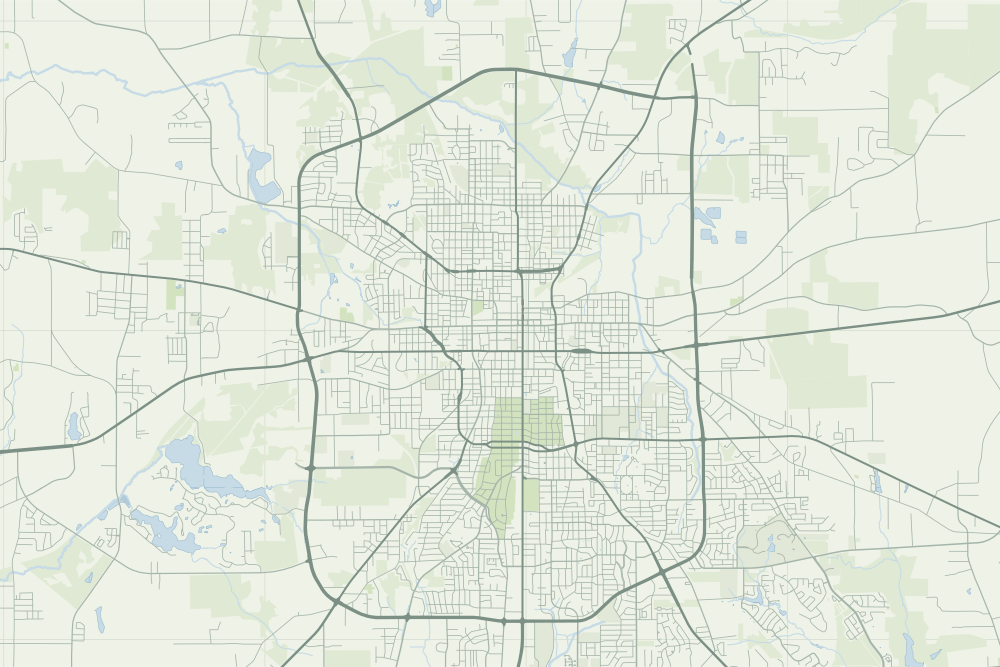
- The track on the map is the railroad as OpenStreetMap draws it today. Where it ran in a given year is on the historic map under the plate for that year, from the first Sanborn key map of 1889 on.
- The faint linework is today’s map, from OpenStreetMap. How the map is made.